Villa Tafuri


ABOUT
Villa Tafuri dominates in silence the splendid Salento countryside.
It can be defined one of the oldest villas in Salento.
It was born as a watchtower in the Middle Ages, while during the Renaissance period it underwent a considerable expansion, commissioned by the noble Tafuri family, in order to transform it into a splendid country villa (Maniero), between vineyards and olive trees.
In the past it was used as a summer and autumn residence in order to control the harvests.
Born on an area rich in historic houses a few minutes from the sea, it has a strategic position among the towns of Galatone, Galatina and Nardò, offering numerous cycle routes between dry-stone walls and typical Salento vegetation.
GALLERY


OUR SERVICES
Location
In the villa normal bikes are at your disposal, but you can also rent our electric bikes or scooters at a cost of 20 euros per day.
Garden
The 4-hectare park surrounded by ancient dry-stone walls allows for long walks with the experience of harvesting vegetables and fruits every day of the year.
Pool
The long swimming pool allows you to cool off on hot days, enchanted by the scents of aromatic plants and citrus flowers.
Dimensions: 12 m x 4 m
Free Wi-Fi
Wifi present in the Villa.
Daily Housekeeping
You can opt for the daily cleaning service at a cost of 20 euros per hour. The Villa is equipped with a washing machine, but you can take advantage of our private washing and ironing service.
Cooking Service
We offer the best solution for a private chef in the Villa on request.
You will taste the organic products of our countryside to immerse yourself in the Mediterranean cuisine.
EXPERIENCES
Visit Historic Houses
We organize visits among the ancient historic houses to discover the Salento Baroque and eclecticism, with circuiti among ancient villages, secret gardens, noble palaces and monasteries.

Mediterranean cooking courses
Our chefs directly in the Villa to learn the basics of Mediterranean cuisine
using the products
of our vegetable garden.

Boat rental
You can rent our motor or sailing boat and discover the Ionian sea during your stay.

Excursions among the Parks of Salento
We organize numerous excursions in the parks
or to the sea for you.

We organize guided tours
and tastings to discover Negroamaro and Primitivo wines in the main
Salento wineries.

We organize private tours with accredited guides for visits to ancient villages and cities of art.

Working and discovering the different stages of
organic activity and tasting
the fruits of one's labour.

We are promoters
of cycle tourism among
the old houses and parks.
We organize bike excursions between the various
Salento villages.

Wineries Tours
Organic
Agriculture
Visits
in cities of art
Paths
cycling tours
THE GARDEN


![PHOTO-2020-10-14-11-24-29[6].jpg](https://static.wixstatic.com/media/f8477f_a466db0a36cc433ba5a12cb9965e93cc~mv2.jpg/v1/fill/w_2175,h_1393,q_90,enc_avif,quality_auto/f8477f_a466db0a36cc433ba5a12cb9965e93cc~mv2.jpg)


OUR ORGANIC PRODUCTIONS
ALL PROPERTY VIDEOS
LAYOUT

HISTORY


Villa Tafuri
A rural noble residence of late Renaissance layout with Baroque elements, set in the Salento countryside, Villa Tafuri is a rare example of aristocratic rural architecture in the region, dating most likely to the late 16th or very early 17th century. Built by the noble Tafuri family—one of the oldest and most influential in Galatone—the villa embodies the transition from late Renaissance style to the early Lecce Baroque, with a solid, symmetrical structure enriched by carved carparo stone decorations.
The main body features a highly symmetrical noble façade, marked by a central loggia with round arches, square-section columns, and an upper floor adorned with windows framed by Baroque mouldings and oval oculi set beneath the cornice. At the top centre stands the family’s noble coat of arms, a proud emblem of their belonging to the ancient Galatonese aristocracy.
At the rear of the villa, a second trabeated loggia with lowered arches is set within a massive, unadorned wall, in keeping with the agricultural function of the villa-farms of the period. The residence was indeed intended both as a noble country retreat and as the administrative centre for the vast surrounding rural estates.
The architectural ensemble blends defensive, residential, and agricultural functions, typical of extra-urban villas in southern Salento. While the decorative elements are more restrained than the exuberant Baroque of Galatone’s historic centre, they nonetheless express the Tafuri family’s intention to assert their rank even in a rural setting.
Inside, the villa preserves a remarkable stylistic coherence, enhanced by a restoration respectful of its original fabric. The interiors feature:
-
An entrance through an ancient olive-wood door
-
Star and barrel vaults whitewashed with lime, adorned with the heraldic emblem of the Tafuri family, such as the crowned shield with a stylised tree
-
An elegant alcove with a mixed-line arch supported by twin columns, originally a devotional space, now adapted as a living area
-
A room with a large pietra leccese fireplace and windows overlooking an agrarian landscape dotted with palms and centuries-old olive trees
On the piano nobile, a magnificent reception hall expresses the baronial elegance and refined taste that define this historic residence.
The space is dominated by a ribbed cross vault resting on robust carparo stone corbels carved with sober elegance. The lime-plastered vault is embellished with hand-painted floral decorations on the capitals, a refined ornamental touch typical of the late Salento Baroque.
Above the doorway leading to the two main bedrooms, the Tafuri family’s noble coat of arms is frescoed directly onto the wall. The shield, supported by two winged putti, is topped by a gem-studded five-point baronial crown, a clear symbol of prestige and authority. At its centre stands a stylised palm, a recurring heraldic symbol in the Tafuri genealogy.
Large openings, including a window overlooking a lush palm grove, bathe the hall in soft natural light that enhances the limestone surfaces and the original wall patinas. The fireplace, simple yet monumental in pietra leccese, further enriches the space, evoking the warmth and solemnity of noble country residences.
This room, balancing monumentality with decorative grace, represents the symbolic heart of the villa—a place of welcome and prestige intended to manifest the family’s rank.
From the central hall, a door to the left leads to a bedroom. The space is dominated by a plastered vault whose ribs converge towards the centre, where a devotional fresco is framed.
The vault and its symbol
On the ribs of the vault is likely an incised design resembling a cross pattée or Maltese cross, a heraldic motif of Crusader origin associated with the Order of St. John, but also widespread in Salento from the 17th century as an apotropaic sign or expression of personal devotion. The Tafuri family, part of the ancient nobility, may have adopted this symbol to claim a chivalric heritage or as a sign of militant noble faith. However, it could also be purely decorative, in line with the painted or incised vaults of many rural and monastic residences in Salento.
The fresco: The Man of Sorrow
At the centre of the vault is a well-preserved fresco depicting Christ at the Column, also known as the Ecce Homo. Christ is shown half-length, crowned with thorns, his hands bound, his gaze lifted heavenward. He is surrounded by four cherubs, with a large cross rising behind him. This iconography is closely linked to the Passion and, in particular, to the representation of Christ’s human and redemptive suffering.
Its presence in a noble bedroom confirms the tradition—common in Apulia between the 17th and 18th centuries—of using domestic spaces for spiritual meditation.
The rectangular room has a lowered-arch window overlooking the garden. On one side wall, a wall niche likely once held a chamber pot or a small devotional object. The walls show signs of time and layers of plaster, bearing witness to centuries of habitation and domestic life.
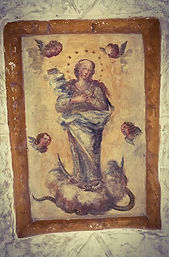
The second bedroom, located in the right wing of the piano nobile, is one of the most spiritually evocative spaces.
The vault is supported by four corner columns (partially embedded in the walls), each with a moulded stone capital from which the ribs spring. This arrangement recalls architectural solutions typical of 17th-century baronial residences in southern Italy, with clear conventual influences.
The Marian fresco
At the centre of the vault is a precious fresco of the Immaculate Conception, identifiable by its traditional iconography:
-
Mary stands upright, wrapped in a celestial-blue mantle and encircled by a halo of twelve stars, a symbol drawn from the Book of Revelation (“A woman clothed with the sun, with the moon under her feet…”).
-
At her feet appear the crescent moon and the serpent, symbolising her victory over sin.
-
Her serene, inspired face is surrounded by flying cherubs, underscoring her heavenly nature and divine intercession.
This image reflects the deep devotion to the Immaculate in Salento, especially after the dogmatic recognition of her sinless conception, and testifies to the Tafuri family’s wish to invoke her protection, purity, and blessing in the most intimate quarters of their home.
The floor is in original cocciopesto, a lime and crushed-brick flooring material typical of prestigious rural residences.
The park and rural architecture
The villa is set within a large private estate enclosed by ancient dry-stone walls, in keeping with Salento’s agricultural tradition. The entire property preserves its historical and functional character: at the main entrance to the park, two monumental pillars lead to a small barrel-vaulted structure with original stone mangers, once used as stables for horses and working animals.


.jpeg)